Yeah, I have been slackin' on the blog, these days, life has intervened a bit. The posts are stacking up like speakers in my closet...
In the meantime here is a version of Motorcycle Girl by Tito & Tarantula. Tito Larriva was the charismatic front man for the Cruzados, a great L.A. Chicano punk band that fizzled out after a great first record. I couldn't find a copy of the official Cruzados video from '85, but this is a scorchingly good version.
Tito's voice has a bit of road rash, but the band is in fine form. The video is from the German RockPalast and was recorded (very well) in Bonn in '08. I think the line up includes Cruzados ex Steven Hufsteter on lead guitar, Lucy Rippy on bass, and Alfredo Ortiz on drums. (I think... This band has been through some changes.) If Ortiz' drumming on this track doesn't have you bopping in your chair you are without hope.
As a parting shot here is an earlier incarnation of the band sharing the stage with Selma Hayek and a snake.
Yowza. Now that's what I call a show! The band contributed 3 songs to Robert Rodriguez' remake of Desperado in '95, and Tito scored the soundtrack.
Tito Larriva and Steven Hufsteter are currently residents of Austin, no doubt Robert Rodriguez had some influence there. Lucy Rippy is also a Texas resident, maybe even an Austinite as well. Austin will make room for Betty Page playing bass any day. That's a two-fer just made for South Austin. For the link inclined here are a few: Tito, the band, The Cruzados, Rippy on MySpace, and Alfredo Ortiz.
Sunday, February 14, 2010

Sunday, January 31, 2010
A simple vacuum tube amp

I've owned and serviced quite a number of pieces of tube audio gear over the years. I've even owned more than a few bits of tube gear in the past that are quite sought after these days. Many were were a mixed bag to own and feed. Especially when the output stage becomes unstable, and eats an expensive set of tubes. My goal was to create something simple and musical. Hopefully, it wouldn't cost an arm and a leg.
Anyone who has built just about anything from scratch will tell you that the cost of materials and labor far outweigh the cost of an assembled product from a store shelf. It certainly turned out to be the case here. A pretty decent power amp could be purchased just for the cost of just the resistors and capacitors in this particular amp. Holco precision resistors, and Sidereal poly capacitors did add up. Throw in teflon coated silver stranded wire, and silver plated ceramic tube sockets, and cost added up even more.
The start of this project began with a set of transformers from an old Sansui unit. They were in great physical condition, and well suited for a project like this one. The output stage takes cues from both the Sansui they originated from, but from some Fisher influence as well. Unlike many common cathode designs of the 60s, I chose a simple self bias approach used in a smaller Fisher 6L6 based amplifier designed many moons ago. No tweaky bias adjustments needed at all.
Looking to cut costs somewhere, I discovered that the Pilot company used a simple 12AX7 tube for each channel of a power amp delivered in the 1960s. Half the dual channel tube used for the input stage, and the second half for the driver/phase splitter. The credit belongs to these trailblazers, and not me. The result is a musical amp that won't cost your entire rent check to feed with tubes. The cathode bias approach definitely squeezes a long lifespan from the power output tubes. Common cathode proponents might claim tighter bass, and a few more watts of power, but I say the trade-off is well worth it.
This amplifier is currently on display at Austin Stereo in Austin Texas.
Sunday, January 17, 2010
The Audio Research SP3A1

Produced around 1973 to 1974, this vacuum tube preamp definitely raised the bar for the state of audio gear. Many manufacturers had already made the transition to solid state circuitry for their entire model lines. Audio Research (often referred to as ARC) would soon follow with their own solid state audio amplifiers. The basic design of this preamp would continue to evolve for years to come, and carried on in models like the SP6, SP8 and SP10.
Features like a cathode follower buffer stage, a bypassable tone circuit, and a solid state voltage regulator were among the unusual features offered by the SP3. While not new features, few preamps (if any) at the time combined all of them. Add to this a large number of inputs, and a set of AC power outlets on the back that can switch 1200 watts of consumption via a separate power switch. This is great, and even necessary, when using this unit with a solid state power amp. A tube preamp should always be powered on first, and switched off last. Even with modern gear, it's wise to follow this advice.
Of course sound is where the rubber meets the road, and this preamp does not disappoint. Even compared to modern offerings, it can hold it's own. Especially when compared to less sophisticated designs.
This particular example is currently on display at Austin Stereo, in Austin Texas.
Thursday, January 14, 2010
Dude, yer slackin on the blog!
Ah, yes. True. I am now wrapping up week 4 of respiratory distress. And before that was the food poisoning. Normal blogging activities will resume when I can breathe.
But I care about the Club's entertainment. How about this:

What is it?
Glad you asked. It's a 38 pound, bluish gray, extremely high voltage ceramic insulator. That some idiot was using as a planter. Please, show a little respect for an industrial objet d'art. It comes in maroon as well... but that one needs a bit more cleaning.
But I care about the Club's entertainment. How about this:

What is it?
Glad you asked. It's a 38 pound, bluish gray, extremely high voltage ceramic insulator. That some idiot was using as a planter. Please, show a little respect for an industrial objet d'art. It comes in maroon as well... but that one needs a bit more cleaning.
Sunday, December 6, 2009
The Pioneer PD 5010
This CD player was built in 1986 and retailed for $400. It is nicely built, but not nearly as sophisticated as the Sony CDP 650ESD that graced these pages recently.

This post is mostly an excuse to share this link and this second link. These sites contain pretty much identical lists of cd players and identifies their DACs and transports. Cool, but why? you ask.

Well, some people are really obsessive about their DACs and transports. Just google TDA1541 and see what you get.

For the record the PD 5010 uses the Sony CX20152, a dual, 18 bit, two times oversampling DAC. You can see it at the right, above. In the previous picture it is in the far upper right. Note the nice film caps in the output stage to the left of the DAC. The clear ones are styroflex.

This post is mostly an excuse to share this link and this second link. These sites contain pretty much identical lists of cd players and identifies their DACs and transports. Cool, but why? you ask.

Well, some people are really obsessive about their DACs and transports. Just google TDA1541 and see what you get.

For the record the PD 5010 uses the Sony CX20152, a dual, 18 bit, two times oversampling DAC. You can see it at the right, above. In the previous picture it is in the far upper right. Note the nice film caps in the output stage to the left of the DAC. The clear ones are styroflex.
Li' Mar: Making the Best of a Difficult Situation
Ahh, we are back to that troublesome little Marantz, are we? Yep. She has not been forgotten, although it has been tough to tell from this blog. I have been avoiding her.
In our last adventure (It was when??? October??) we made some progress by pulling a wobbly post off the preamp board. That solved a problem, but progress always seems to be followed by a setback with this amp.
Way back in August (!) I had recapped the amp board, and I vaguely recall checking the output transistors, but evidently I was not exactly thorough. With the preamp playing a bit better it was clear that the left front channel had an odd distortion. Mike ran it through the ocilloscope and exactly half of the wave form was missing. Literally. One of the 8 outputs was bad and I had either missed it or it had recently failed. Its mate was working on the positive swing, but the zero line was as far as the signal went.

When one is bad, replace them both.
Here is the board, pulled yet again. The replacements are the clean ones at the left.

Here is the heat sink and goo, the imprint of the dead output is the incomplete one at the top. Hmm, maybe it didn't seat well enough... No need to wallow, there is more trouble ahead!

Replacing an output isn't particularly difficult, but what followed was.
The preamp board: what a pain in the butt. The front channels seemed ok, although once in while it seemed... off. The rear channels were maddening. The treble was behaving like a combination tone control and volume pot all in one. The signal would disappear. The bass pot was more stable, but every once in a while it would distort. Maybe it was salvageable, but that treble pot was more a 'trouble pot'. I chased bad solder joints and bridges for far too long, and finally threw in the towel.
I talked all this over with Mike. His strong suggestion was to cut my losses and just run both front and rear outputs with the front section of the preamp. This was a very easy modification, but I really didn't want to sacrifice the quad features of this amp. I was hoping we could just jumper the rear channel treble pot and salvage as much as we could. Mike did not like this idea at all, too complicated and too many problematic components remained in circuit.
Before we could decide on a plan of attack, life intruded, and Mike had to leave for several weeks to visit his father in Midland. This has been a very tough year on our parents.
This past Saturday we finally had a good day on the bench. We settled on a reasonable plan of attack, and most importantly, Mike did most of the dirty work. So, next time, I promise I will have some good news about Li'l Mar.
In our last adventure (It was when??? October??) we made some progress by pulling a wobbly post off the preamp board. That solved a problem, but progress always seems to be followed by a setback with this amp.
Way back in August (!) I had recapped the amp board, and I vaguely recall checking the output transistors, but evidently I was not exactly thorough. With the preamp playing a bit better it was clear that the left front channel had an odd distortion. Mike ran it through the ocilloscope and exactly half of the wave form was missing. Literally. One of the 8 outputs was bad and I had either missed it or it had recently failed. Its mate was working on the positive swing, but the zero line was as far as the signal went.

When one is bad, replace them both.
Here is the board, pulled yet again. The replacements are the clean ones at the left.

Here is the heat sink and goo, the imprint of the dead output is the incomplete one at the top. Hmm, maybe it didn't seat well enough... No need to wallow, there is more trouble ahead!

Replacing an output isn't particularly difficult, but what followed was.
The preamp board: what a pain in the butt. The front channels seemed ok, although once in while it seemed... off. The rear channels were maddening. The treble was behaving like a combination tone control and volume pot all in one. The signal would disappear. The bass pot was more stable, but every once in a while it would distort. Maybe it was salvageable, but that treble pot was more a 'trouble pot'. I chased bad solder joints and bridges for far too long, and finally threw in the towel.
I talked all this over with Mike. His strong suggestion was to cut my losses and just run both front and rear outputs with the front section of the preamp. This was a very easy modification, but I really didn't want to sacrifice the quad features of this amp. I was hoping we could just jumper the rear channel treble pot and salvage as much as we could. Mike did not like this idea at all, too complicated and too many problematic components remained in circuit.
Before we could decide on a plan of attack, life intruded, and Mike had to leave for several weeks to visit his father in Midland. This has been a very tough year on our parents.
This past Saturday we finally had a good day on the bench. We settled on a reasonable plan of attack, and most importantly, Mike did most of the dirty work. So, next time, I promise I will have some good news about Li'l Mar.
Sunday, November 15, 2009
The Very, Very Rare Sony CDP 650ESD CD Player
This statement piece from Sony Esprit was built in February, 1986 and retailed for $1300. This unit clearly spent its last years in a garage since the back half was completely coated in fur. I spent a good hour cleaning it with cotton swabs and fired it up. It came up nicely on the Sencore Powerite, but the drawer wouldn't open: as usual the rail grease had become rail sludge. So, another 10 minutes of swabbing followed by the oil got the door to open.

There is almost no information on this player on the web. For comparison purposes here is the write up on a Sony CDP 302 from '85 and the very similar Sony CDP 520ES.
This player is very heavy and chock full of copper. It is also chock full o' boutique caps, mostly Elna Cerafines and a few Blackgates. There are 6 op-amps in the analog stage that have copper heatsinks mounted on top, which can be seen at the upper right of the picture below:

The transport is complex:

The drawer action was a bit slow and it skipped occasionally, so we opened the bottom:

Mike said the skipping was caused by a sticking sled, and he was correct. The 650ESD played very nicely post lube. I changed one belt, somewhat unsuccessfully. The second was trickier to remove so I blew it off. My choice of replacement belt was not very good, the drawer action was actually worse afterwards. It will have to wait until next time.
Here is the bottom of the transport. The laser is on a sled that slides front to back, right to left in the photo below. The two belts are at the left, around the white plastic pulley.

This 650ESD is noted as the first cd player with digital out and it is housed in a pod sticking out of the back. Odd. The switch says 'On', 'On (For Audio Use)', and 'Off'. I am not exactly sure the how the two 'Ons' differed. And it has 3 play modes, I am not sure how that works. I might actually have to procure a manual and suffer the resulting testosterone loss.

And a nod of appreciation to Sony, c. 1986.

This is a spectacularly designed and built player. I am not sure what is next beyond belts. There are a few caps that could use a freshen-up, but it is tough to replace Cerafines with anything other than Cerafines. Time to do some research.

There is almost no information on this player on the web. For comparison purposes here is the write up on a Sony CDP 302 from '85 and the very similar Sony CDP 520ES.
This player is very heavy and chock full of copper. It is also chock full o' boutique caps, mostly Elna Cerafines and a few Blackgates. There are 6 op-amps in the analog stage that have copper heatsinks mounted on top, which can be seen at the upper right of the picture below:

The transport is complex:

The drawer action was a bit slow and it skipped occasionally, so we opened the bottom:

Mike said the skipping was caused by a sticking sled, and he was correct. The 650ESD played very nicely post lube. I changed one belt, somewhat unsuccessfully. The second was trickier to remove so I blew it off. My choice of replacement belt was not very good, the drawer action was actually worse afterwards. It will have to wait until next time.
Here is the bottom of the transport. The laser is on a sled that slides front to back, right to left in the photo below. The two belts are at the left, around the white plastic pulley.

This 650ESD is noted as the first cd player with digital out and it is housed in a pod sticking out of the back. Odd. The switch says 'On', 'On (For Audio Use)', and 'Off'. I am not exactly sure the how the two 'Ons' differed. And it has 3 play modes, I am not sure how that works. I might actually have to procure a manual and suffer the resulting testosterone loss.

And a nod of appreciation to Sony, c. 1986.

This is a spectacularly designed and built player. I am not sure what is next beyond belts. There are a few caps that could use a freshen-up, but it is tough to replace Cerafines with anything other than Cerafines. Time to do some research.
Sunday, November 1, 2009
Odds and Ends, Again
Not much to write, but here are a few interesting photos. First up, a CM Labs 911 solid state power amp. Orion says it's from the early 70's but it looks very 60's.

The sides are cast:

According to Mike the build quality is superb, akin to McIntosh of the era.

UPDATE: Rummager has commented on the Bozak and CM Labs connection. Here is a very interesting web site by Bob Betts, several times chief engineer for Bozak. It includes a photo of Wayne Chou. The name CM (or C/M) Labs was a contraction of Chou and Morris. Here is a link to a DIYAudio wiki with information supplied by Wayne Chou. The above amp is from 1966 (!) and was named after the Porsche. CM Labs even produced a speaker, the CM-15, that was designed by Houston's own Louis Erath. (One of these days we hope to have a long write up on Mr. Erath. We have a source!) Thank you for the tip.
Next up, my very early Sansui mono pre/power combo. I assume this is from the 50's. The label on the front says this is an FM 15.

The outputs are 6V6. Note the substantial and lovely output transformer:

And last but not least is the volunteer papaya plant growing in the alley behind Austin Stereo:


The sides are cast:

According to Mike the build quality is superb, akin to McIntosh of the era.

UPDATE: Rummager has commented on the Bozak and CM Labs connection. Here is a very interesting web site by Bob Betts, several times chief engineer for Bozak. It includes a photo of Wayne Chou. The name CM (or C/M) Labs was a contraction of Chou and Morris. Here is a link to a DIYAudio wiki with information supplied by Wayne Chou. The above amp is from 1966 (!) and was named after the Porsche. CM Labs even produced a speaker, the CM-15, that was designed by Houston's own Louis Erath. (One of these days we hope to have a long write up on Mr. Erath. We have a source!) Thank you for the tip.
Next up, my very early Sansui mono pre/power combo. I assume this is from the 50's. The label on the front says this is an FM 15.

The outputs are 6V6. Note the substantial and lovely output transformer:

And last but not least is the volunteer papaya plant growing in the alley behind Austin Stereo:

Tuesday, October 27, 2009
In Celebration of Speaker Day
Around our household we celebrate a number of unusual holidays. One of my favorites (and my wife's) is Speaker Day. On this day all adult males haul out the speakers they have been storing in closets and unused bedrooms and make them ready for the next stage in their lives. While not as festive as the International Day of the Sock, it nonetheless is a lot of fun. Speaker Day could be celebrated pretty much every week around our house.
After a two year drought and a summer of screaming heat, Austin is evidently now enjoying a fall monsoon, so Speaker Day was at risk this past Sunday. But the sun was sort of out, and the ground was sort of dry, so it was on with the celebration.
The star of the festivities was this bottle:

Yes, that is a really old bottle of Sta-Wax I found at an estate sale. (Guess how much I paid for it.) This stuff has an odd, strong smell, sort of like cherries, but it is a wonderful product. It should be used much like lemon oil, but it is much more effective. It is great on open grain wood like the JBL 4410 it sits on. The photo doesn't do it justice: the right half has been treated and the left half hasn't.
Next up, a classic marriage killer:


This is a Knight 2300C speaker in very lovely dark walnut, or maybe mahogany. If you are the sort of husband who can't bear to leave a pair of large real wood speakers to the hazards of a thrift store, be forewarned. You will be shocked to learn that the wife will not like them. Too honkin' big. But if you do save them from further insult at the hands of barbarians, you will discover they have nice Jensen drivers. The 10" woofer is one of their better finished models, with a horn mid and a very interesting looking tweeter. The crossover is nicely done and worthy of some cap rolling fun and games. Oiled up they look great.
Onward to a long sought after speaker: the Optimus 10. Long ago (as in at least 30 years ago) I read a very nice review on them and thought I would like to give them a listen. Time passed... This is the one an only pair I have ever seen and I literally pulled them out of a huge salvage box at our crazy Goodwill dumping ground. The grill was shattered and the foam surrounds were long gone. I out them back together and even put a nice cap on the tweeter. It is just amazing what a male of the human species will endure for the love of a loudspeaker. The Optimus 10 has a decent dome tweeter with an 8" woofer and a 10" passive radiator. And the tweeter control even has a nice response curve which no doubt is completely accurate. I have yet to give them a real listening, though, I guess I need to find the time after all that effort.


Last on tonight's program is a very sweet EPI 100W, the real walnut veneer variety. I have had a soft spot for these speakers since '74 when I dropped most of a paycheck on a pair with the lovely brass inlays. Peter Frampton sounded great for a week, but then I was burgled, so I have been compensating for that loss ever since.

I neglected to take picture of several other Speaker Day participants, including entries from JBL, Mirage and Heathkit. The next Speaker Day is not that far off, so I better keep that camera warmed up.
After a two year drought and a summer of screaming heat, Austin is evidently now enjoying a fall monsoon, so Speaker Day was at risk this past Sunday. But the sun was sort of out, and the ground was sort of dry, so it was on with the celebration.
The star of the festivities was this bottle:

Yes, that is a really old bottle of Sta-Wax I found at an estate sale. (Guess how much I paid for it.) This stuff has an odd, strong smell, sort of like cherries, but it is a wonderful product. It should be used much like lemon oil, but it is much more effective. It is great on open grain wood like the JBL 4410 it sits on. The photo doesn't do it justice: the right half has been treated and the left half hasn't.
Next up, a classic marriage killer:


This is a Knight 2300C speaker in very lovely dark walnut, or maybe mahogany. If you are the sort of husband who can't bear to leave a pair of large real wood speakers to the hazards of a thrift store, be forewarned. You will be shocked to learn that the wife will not like them. Too honkin' big. But if you do save them from further insult at the hands of barbarians, you will discover they have nice Jensen drivers. The 10" woofer is one of their better finished models, with a horn mid and a very interesting looking tweeter. The crossover is nicely done and worthy of some cap rolling fun and games. Oiled up they look great.
Onward to a long sought after speaker: the Optimus 10. Long ago (as in at least 30 years ago) I read a very nice review on them and thought I would like to give them a listen. Time passed... This is the one an only pair I have ever seen and I literally pulled them out of a huge salvage box at our crazy Goodwill dumping ground. The grill was shattered and the foam surrounds were long gone. I out them back together and even put a nice cap on the tweeter. It is just amazing what a male of the human species will endure for the love of a loudspeaker. The Optimus 10 has a decent dome tweeter with an 8" woofer and a 10" passive radiator. And the tweeter control even has a nice response curve which no doubt is completely accurate. I have yet to give them a real listening, though, I guess I need to find the time after all that effort.


Last on tonight's program is a very sweet EPI 100W, the real walnut veneer variety. I have had a soft spot for these speakers since '74 when I dropped most of a paycheck on a pair with the lovely brass inlays. Peter Frampton sounded great for a week, but then I was burgled, so I have been compensating for that loss ever since.

I neglected to take picture of several other Speaker Day participants, including entries from JBL, Mirage and Heathkit. The next Speaker Day is not that far off, so I better keep that camera warmed up.
Saturday, October 24, 2009
A New Sign O' the Times
Austin Stereo Service got a new sign today:
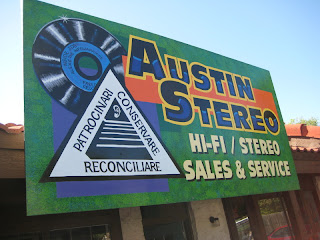
First, new carpet, and now a new sign. The club house is looking pretty swank these days.

First, new carpet, and now a new sign. The club house is looking pretty swank these days.
Subscribe to:
Posts (Atom)