Monday, February 9, 2009

Success!

In our last episode of Soldering Iron Justice, our intrepid technician was befuddled by a capacitor that was really a thermistor. Could the part be located? Would it in fact enable the repair? Could sonic mojo be restored to the Stax Earspeaker Energizer, SRD-7?


It turns out, the answers were and are: yes.

Mouser Electronics to the rescue! They sell Murata thermistors, in this case 4.7 ohms @ 140 volts. They are a fraction of the size of the torched thermistor, but I can live with that especially since the prior examples were bent to fit and one lay across a wire wound resistor which contributed to its demise. I purchased 2 for the sake of symmetry, a buck each.

My original effort on the SRD-7 was to replace the pair of 1 mfd 160 volt electrolytic caps with fairly compact polpropylene 250 volt caps. The new thermistors were a bit tricky to install because they were nearly too small for the leads to reach, but with a bit of gentle coaxing they reached and the solder grabbed.


In the photo above, the thermistors are the brown disks above the left hand transformer. The right one is torched. A black wire wound resistor is next to each thermistor. The 1 mfd film caps are the white lozenges in the middle of the board. The small, loose caps at the top were the originals, now removed. Time passed... and the thermistors were subsequenty replaced.

I brought the SRD-7 up on the variac without any smoke so I hooked up the pair of Stax SR-X Mark 3's. The energizer was driven by the trusty Advent 300 and when it was lit I heard sweet, sweet music.
Electrostatic headphones are ear candy deluxe. If everyone on earth had a pair connected to an Advent 300 there would be no war. Tripping Daisy would be everyone's favorite band. The sound is effortless and extended. Listening to Austin's classical station, KMFA, I could clearly hear the crappy digital sideband hiss, but the music sounded so good I really didn't care. I am not sure I can give higher praise without an eargasm.

Given the age of the SRD-7 (introduced in 1971) it would seem to me that the first order of business for anyone who owns one should be to replace the two electrolytic caps. I also wonder about the location of the thermistors since the originals are large and easily bent over to touch the large resistors next to them. Not good. Only 4 screws separate one from peace of mind, so open it up and make sure the thermistors are not bent over, touching the resistors. Only 2 more screws need to be removed to actually work on the unit.

If you have a chance to acquire a pair of Stax headphones, I highly recommend that you do. You will thank me. And you're welcome.

Wednesday, January 14, 2009

Capacitor Codes!

Learn something new every day, they say. I have been stumped by a largish Murata ceramic capacitor that does not seem to be working. It's from a Stax SRD 7 electrostatic headphone energizer, c. 1975. Its mate is a charred mess so I have not been able to test either.

Here is the legend on the cap: PTH BD 4R7M

It's apparent that this is a standard value 47 (something) but where is the decimal point and what is the voltage?

Transtronics' wiki comes to the rescue on capacitor codes.

The 'BD 4R7M' is evidently a military style code. The R substitutes for the decimal point. There is not a number following the R so there is no multiplier. So, it seems that this cap has a value of 4.7 pico farads, about as small as is measurable. The B indicates that a capacitance drift is not specified. The D is the voltage rating, 500 volts. The M indicates the cap has a temperature range of -55 to 70 °C .

UPDATE: a good question has been raised in the comments. The number 7 is evidently never used as a multiplier as indicated in Table 1. The multiplier format would be something like 474 which would indicate a value of 47 times a multiplier of 10,000, or 470,000 picofarads which is the equivalent of .47 microfarads. It seems to me that one would either have a R for a decimal point or a multiplier but not both at the same time. I guess neither would be necessary for a 10 picofarad cap which could be represented with just a 10, but that actually is a 10_ with the (blank) implying a multiplyer of 1. Whew.

Despite its rather significant size this is a pretty low spec cap.

Now, what about the 'PTH'? A bit of googling reveals that 'PTH' is a registered trademark of Murata and indicates the cap is actually a PTC Thermistor... What???

A thermistor is not a cap, it is a sort of current limiter whose resistance varies with temperature. PTC stands for 'positive temperature coefficient' which means the resistance goes up as the temperature goes up. But the codes on the item conformed to a capacitor!

So, it appears that today I have learned that I am confused. I wonder if in 1975 the PTH was used as a different indicator for Murata and it is indeed a 4.7 pico farad capacitor, or perhaps those codes do double duty and are used as indicators for the various qualities of a thermistor. The charred condition of the second 'cap' might indicate it is actually a thermistor that gave its life to protect the SRD 7. Hmmm.

Back to the Transtronics wiki page on resistor codes...

If a thermistor is coded like a resistor it would seem that this device has been coded via the BS 1852(British Standard 1852) and has a resistance of 4.7 ohms with a tolerance of 20% (M). The 'B' and the 'D' are not addressed. Therefore I would guess that it is not a coincidence that the device in question does, in fact, measure a resistance of 5 ohms.

Obviously, more research is needed.

Saturday, January 10, 2009

The World's Finest 8 Track Collection

Ahh, 8 Track tapes: anachronistic, clunky, low-fi and heat damaged from all those hours in cars sitting outside in the screaming Texas sun. One of the technological miracles of the '70s was an 8 track tape that would play long after the label had the color sun-blasted from it. They were serious yard sale fodder of a generation ago, but they are getting a bit rare these days.

A disproportionate number of surviving 8 tracks are by artists like Ray Conniff or the Carpenters. Not that I am sneering at Ray, Karen and that guy playing the piano. But, really. Were all those Camaro and Cutless drivers that focused on staying in the middle of the road? Didn't anyone have a really killer 8 track collection back then? This question has not exactly haunted my every waking hour for the last 20 odd years, but I have wondered. A bit.

If you think about it (and although it is pathetic and sad, I do), the 8 track question really is one of survival. It would seem to me that your average rocker with a beater of a car kept his 8 tracks on the floor or the seat. His mom kept hers in the carrying case. So Ray and Karen survived and Pink Floyd went into the trash when the label was no longer legible. So that killer 8 track collection needed to have been owned by an anal retentive rocker (has one ever existed??) for me to find it all these years later.

Eventually all things come to he who waits. Just the other day I discovered that there was at least one person who had a great collection of 8 tracks and, in fact, stored it in an industrial strength suitcase. Maybe his mom made him do it, maybe it was his own unnatural instincts, but whatever. I am thankful. Here is a smattering for your viewing pleasure:

Mott the Hoople??? Savoy Brown??? There was even a Redbone tape in the pile. Several were quad tapes, and all were in great shape. Now I need to finish the 8 track receiver project and give them all a listen.

My compliments to the collector, whoever you were.

Tuesday, January 6, 2009

The Sony CDP 520ES CD Player

This is just too rich.

Here is a photo of the innards of this $600 list, vintage 1985 cd player:


Hmm, does this look familiar???

It is a dead ringer for the innards of the non-Esprit CDP 302 cd player documented a few days ago. The exterior is also identical, save the name. Whatever could justify the Esprit badge? Could it be... why yes it is. Here tucked in the corner are a few differences:


Yup, 4 boutique caps, the round red 'uns at the lower left and at the middle and lower right (one is just peeking through the wires. These are Elna Cerafines in the analog stage, right where I put a pair of Elna Silmic II's and a pair of Panasonic FM's in the 302.

Oh, yeah, there is one other difference. The 4 power supply caps of the 302 included 3 3300 mfd caps and 1 4700 mfd cap. Two were black Nippon Chemicon SM's and two were blue NXD's. The 520ES has 3 at 4700 and only 1 at 3300, so the power supply was slightly beefier. These are the 4 large blue caps (all Nippon Chemicon NXD's) at the top of the photo above.

Now there could be a bit more to this than meets the eye. Sony could have done some hand matching/selection of components and maybe there is something different about the chip set that I cannot see. But still.

So, in 1985 the price of 4 small boutique caps, a very slightly beefier power supply and a some Sony ES bragging rights was 50 bucks.

UPDATE: I just hate it when I miss something. There is a slight difference in the transports at the left rail. The rail is visible in the 302 but not in the 520ES, plus there is a slight difference in the back with a small board mounted differently. Now I am going to have to pop the tops again...

Sunday, January 4, 2009

The Sumo Gold Power Amplifier

Every once in a while Mike feels a need to remind me that should I ever stumble across any Sumo amp, he wants it. Sumo was the creation of audio legend James Bongiorno of SAE and GAS (Great American Sound) fame and Bongiorno is one of Mike's heroes. Since I evidently don't get out much, my exposure to Sumo had been limited to the delightfully named Charlie (the tuner) until last Saturday when a Sumo Gold walked through Mike's door.

That is a bit of an exaggeration since Sumo amps are huge and need significant help moving around. Here it is:
The Gold was in very respectable shape with just a dent on the lower right corner, the bane of many a very heavy amp. It was in for a very brief check up and put on an impressive demonstration with the Infinity Quantum 2 speakers just visible in the photo above. Mike's Quantums are not exactly favorites of mine, but they sounded good driven by the Sumo. The bass extension and control was absolutely stellar on Mike's organ demo disk.

Here is a photo of Jay, the proud owner of the Gold:


Jay, you are now officially famous, an intrinsic part of the Great Internet. For those of you not from Austin, this is how all of us look. Gimme caps, tee shirts and stubble are what make Austin great. Well, that and a local beer in hand like a Shiner or a Real Ale from Blanco, Texas.

Yesterday, Jay and his friend Tom informed me that they had each just purchased Sumo 9 amps (sort of) via eBay although eBay had messed with them quite seriously. With luck the 9s will be documented in the not so distant future. (And many of us are debating how long before eBay just crumbles under its own jerkiness. Maybe more on that sometime in the future.)

In the interest of completeness, here is a photo of the Gold, just a bit naked:


Jay was driving the Sumo with the interesting Northern tube preamp, pictured below. It drove the amp quite nicely and the build quality seemed good. I think this is Chinese made, proof yet again China can be more than just crappy DVD players sold at Walmart. See the earlier article Bill did on the Yaqin amp.

And one last photo of Mike, bopping to Copland's Fanfare for the Common Man:

All Austinites are required to wear tie dye at least one day a year. Mike takes his tie dye seriously and tries to observe at least one day a week. Mike is also wearing the mandatory magnifyer (techs only) but he is in serious violation of Austin's smoking phobia. We are still working on that aspect of Mike.

Lastly, thanks to Kevin for the photos. (And let me be the first to congratulate him on the web for his future arrival. No, not an amp: Kevin is going to be a father! The Stereo Club is thrilled at having a new junior member and vows to outbid People Magazine for the first photos.)

Thursday, January 1, 2009

The Sony CDP 302 CD Player

Not that one can tell from this blog, but I really do wield a soldering iron once in a while.

Lately I have had this hankering to revisit the quality CD players of yore. Back when the Ipod listeners among us were in diapers, CD players cost serious money and were actually made of metal and stuff. Inside of these vintage units were parts galore, not just air and a couple of chips. These were serious components built to last a lifetime, i.e. built to actually be repaired instead of chucked in the landfill. These were often very spartan players by modern standards because features (like a headphone jack!) cost you dearly. Over the last few months I have acquired several vintage players in working condition, something I absolutely guarantee will not be possible with the vast majority of current CD/DVD players, and I hope to restore and document a few of them.

The first up is the Sony CDP 302 which was manufactured in 1985 and listed for a non-trivial $550. It powered up and did its best to find the index, but the belts were crispy, of course, so it would not play. I begged belts from Mike, swabbed a few nasty bits, applied a few drops of oil and it worked. Interestingly, it easily played modern burned disks.

The CDP 302 has a nice bottom plate so access is easy. Therefore, I figured it was time to try a total re-cap to see how it would sound. I replaced a total of 44 caps with mostly Panasonic FCs, with a smattering of FMs. The final output coupling caps were replaced with Elna Silmic IIs. The 4 3.3k mfd power supply caps were boosted a smidgen to 4.7k at a slightly higher voltage.

Here is a topless shot:Build quality is very good. The transport is a hoot, stainless steel rails and all. Mike had never seen this mechanism before. The lubrication on the rails had turned to goo so the door barely opened at first. And it has a real transformer, not the chimpy sort of thing found in a modern player. The board at the left is lovely, with the very detailed legend actually printed on both sides. Eg. cap C 351 is identified on the trace side, a very nice touch. The output stage has a significant number of film caps, and there are a total of 6 of those cool clear copper foil caps between the DAC and the output. They obviously cared about the A in the D to A.

Here is the flip side:

The traces were fairly stout although I had several lift when doing hot pulls. Wicking was easier on the traces. Look at all the metal in that transport! Sony is currently a maddening manufacturer. They obviously have lots of very capable engineers, but many of their recent products have very serious QC issues. However, they obviously cared back in 1985 when they built this CD player.

I have been mulling over the CD source at the dawn of the medium, and why it took so long for CD sound to be competitive with that of vinyl. First, CD players were incredibly expensive, so the best of the players were very rare. The vast majority of us heard CD via down market, early generation players because that was all that was affordable. Second, the art of actually producing a CD was primitive, so much of what was available was crap compared to vinyl. Garbage in, garbage out as they say. On the other hand, designing a quality analog stage was easily attainable. Digital processing was a new art at the time, but the analog side of the equation was not. It has seemed to me that a spruced up, high quality vintage CD analog section could blow away your typical modern CD/DVD analog section. So, the sum of these theories has been that the top of the line vintage CD players are worth pursuing despite some digital conversion inadequacies, especially since they are so very cheap to acquire. With new belts and caps the game is afoot!

So, how does the re-capped and re-belted CDP 302 sound?

Very, very good it seems. In fact, it sounds so much better than my workshop Marantz CDR 630 (Professional!) that I am afraid I need to take a soldering iron to it. I hadn't realized how veiled the Marantz sounds. The first few minutes of the Sony were a bit inconclusive, but within 5 minutes the new caps settled in and the sound just opened up. This is a very smooth and detailed player. It gets a bit confused on complex passages, but it sounds great with female vocals. I need to let it burn in a bit more, but the reclamation project has already met my expectations.

UPDATE: it seems that Mike has a Sony CDP 520ES that at least superficially is a dead ringer for the CDP 302. Next week I will pop the top to see what's makes the 520ES worthy of the Esprit line.

Here is one last shot from the front, and I really need to take better photos:

Saturday, December 27, 2008

Pioneer SPEC 4 Amp Repair

I first saw and heard a SPEC system set up back in 1980 when I was stationed in Guam while in the Air Force. I never forgot it and 20 something years later, I finally got a chance to get my hands on a SPEC 1 pre-amp and a SPEC 4 power amp in very good condition. I had already had the other pieces of my system and was using a nice Pioneer SA-9500 II to power the restored Bose 901 Series IV's, which took me the better part of a month to bring them back from the dead. When I hooked up the SPEC 1 and 4, there was no comparsion. The depth and clarity of the music that the SPEC components produced went way beyond what the 9500 II could muster. I was in heaven...... for a while. About six months later, I got up one morning and went to turn on some tunes like I did every morning and flipped the power amp switch on and nothing. No lights, no nothing. I knew I was in trouble. I live in North Alabama and there was no repair shop anywhere around here that was capable of this kind of work, but I took a chance and carried it to a local electronic shop anyway, mostly out of desperation. Here, let me give a word of advice to anyone who needs a vintage stereo component repaired: if the place you take it to has alot of TV's sitting out, turn around and walk back out the door you came in. That guy kept it a month and was no closer to repairing it than the day I brought it in. Finally, I'd had enough and starting looking around on the net for a real repair shop to ship it to. I looked a several ads and read their sales pitch and then I saw and read the reviews for Austin Stereo Repair in Austin, Texas and knew this was the place I wanted to work on my SPEC 4. Mike, the guy who runs the shop, was very nice and kept me informed of everything and every step of the repair process that he was making. The turn around time was a bit longer but that was entirely my fault. He told me exactly how to pack the amp to ship to him and like a idiot, I didn't listen to him and tried to save a few bucks by not wrapping it in bubble wrap. The amp arrived with a busted bumper on the back. It could have been alot worse and I learned my lesson. If you ship to him and he tells you how to pack it, take my advice; do it! Finally, I got it back and let me tell you, I cannot write a good enough review for the work Mike performed. It sounds better than it did before it died! Also, this guy must be a clean freak because you can eat off the inside of this amp! Austin Stereo has my business from now on. Thanks Mike!

Monday, December 22, 2008

Encore from Gothenburg

Johan Persson has kindly provided several more photos of his collection.

First up are a pair of snapshots of the diminutive component that I commented on in the earlier post. It is another marque that I have never encountered (or even heard of!): Skantic. I love the simple elegance of these northern European designs. I must say I am still a bit perplexed as to whether this is actually an integrated amp or a preamp. The bird logo is very reminiscent of Fisher. The legend above the knobs and switches just cracks me up. I would guess volume, balance, bass, treble, phono, tape, radio (duh), and power...

The single external transistor really has me puzzled. It says stereo on the front??!! I really need to know my Din connectors better to sort all this out. It also seems to have 3 fuses, generous for such a tiny package. Update: it was actually easier to see via the blog. Interesting. The speaker connectors are far right and left, above the fuses. And Mike says the single external transistor is part of the regulator...

And last, but not least, is an absolutely gorgeous Ravensbourne tuner/integrated pairing from Rogers, down Angleterre way. From the photo Johan has the original literature as well. I am incredibly jealous.


The large screen on top of the tuner case would suggest this is a tube tuner?? It would seem to have a tuning eye to the right of the scale. These are just lovely. My semi-useless Orion Blue Book lists the amp as being produced from '73 to '77. I have my doubts, these would seem to be earlier items. I recall this is Orion's default time frame for those moments when they are clueless. Time to email Johan for some more information...

Wednesday, December 17, 2008

The Goteborg Chapter

It seems The Stereo Club has a previously unknown chapter in Goteborg, Sweden.

Goteborg, city of the Goths, and otherwise known as Gothenburg to those of us in the states, is a nicely sized city of half a million on the southwest coast of Sweden. It is home to the largest university in Scandinavia, as well as the bands Ace of Base and The Soundtrack of Our Lives. (Hmm, not so different from Austin, Texas.) I confess the former band is a guilty pleasure and the latter is a not so guilty pleasure.

I have recently had the pleasure of exchanging emails with Johan Persson, an avid collector of '70s stereo components from Gothenburg. Johan has a very substantial collection of Pioneer, Marantz, and Tandberg equipment, as you can see from the following. First up, Pioneer::


Here is a stack of Marantz gear:


And a very tasty selection of Tandberg equipment:


I really need to find out what the little amp on top is. I am a sucker for smallish Euro amps.

Johan says this is a stack of a Swedish DIY kit amps sold in the '70s under the names Sentec and Semicon:


I have never seen these before.

And some Akai gear:


All the above are normal obsessions, although in total perhaps a bit extreme. My wife sends her condolences to Johan's wife. However, the following obsession with headphones is new to me. I have the normal 7 or 8 headphones. This is truly impressive:


Johan: thanks for the photos! And welcome to The Stereo Club!

Tuesday, December 2, 2008

Apex Jr.: Your Source for Affordable Electronics

About a year ago I was poking along down the Information Highway, doing a bit of research on the Realistic Minimus 7 loudspeaker. I stumbled into a thread on AudioKarma that suggested an interesting tweeter replacement could be found at a site called Apex Jr. ApexJr.?? Whatever is an Apex Jr.? I followed the link and answered that question.

It turns out that Apex Jr. is the nom de web of Steve Slater. Steve is pretty much a lifelong veteran of the electronic surplus business and "Apex Jr." was originally how he answered the phone as a kid at his father's surplus business, Apex Electronics. About 16 years ago Steve started his own business and those of us with gear to fix (or build) are the beneficiaries.

Apex Jr. is an online electronic surplus store that specializes in audio components. Steve has a healthy selection of subwoofer amplifiers (see this earlier post), including both the Miller and Kreisel 150 watt and 250 watt units. For the speaker builders and restorers among you he has a host of speaker parts including drivers, binding posts, capacitors, resistors, and wire. Like all good surplus stores he has his share of those uncategorizable items that make for a fun browse. Here is a sampling of some of my recent purchases from Apex Jr.:


Starting from 12 o'clock: a BMI 33mfd/450v axial capacitor; a Nichicon 12000mfd/50v capacitor; a truly huge rubber foot; rca connectors with strain relief; a pair of heavy duty speaker binding posts; a Nippon Chemi-Con 15000mfd/63v capacitor. In the center is the Sonance tweeter that can be used with the Realistic Minimus 7.

Steve's prices are extremely reasonable and the quality of the merchandise is first rate. The 15000mfd caps above are a huge bargain at $2.99. They are a no-brainer power supply upgrade for a significant number of '70s receivers. The binding posts are very heavy duty, and are much better than replacement quality.

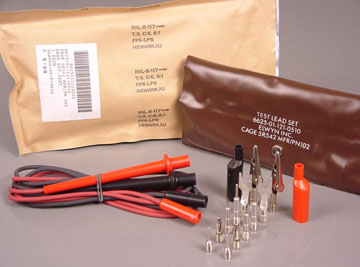
I highly recommend the 16 piece test lead set for $9.99 pictured here. Mike's comment on seeing mine: 'That's old school.'

I have placed 3 orders with Steve and each has arrived within 2-3 business days, nicely packed. Steve takes credit cards, but has to charge a 3% upcharge to keep his overhead low.

Give Steve a call at 866-4-ApexJr. For those of us more numerically oriented that is (866) 427-3957. Oddly enough, he does not list his business hours. I know he has customers as far away as New Zealand, so I bet he gets phone calls at some very odd hours.

Steve is based in La Crescenta, California. His main warehouse (of 3) is located by the 2 and 210 freeways and vistors are welcome, although by appointment. It should be noted that Steve has many more items than those displayed on his web site. Here is just a portion of one warehouse: